Sunday, 16 December 2012

Hyundai i10 Kappa Review

Design and Engineering


In tune with the step up in performance are the aggressive looks. The smiling front has gone under the knife and it now looks more mature. The larger hexagonal grille mimics Hyundai’s family look, the new headlamps look classy and the front bumper now houses a larger air dam.
The outside rearview mirrors on the top-end variant come with integrated turn indicators and body coloured mouldings. The rear bumper too comes with a body coloured rub strip as compared to the black-coloured one on the old i10. The re-sculpted rear bumper also gets reflectors and parking sensors. The design of the tail-lamps has been tweaked as well, giving it a more angular look.

Interiors

On the inside, the all-beige interiors are now replaced with a two-tone finish. The dash now sports a dark grey colour and, thanks to the darker shade, it no longer reflects in the front windscreen on sunny days. Otherwise, the design and layout of the cabin are similar to the outgoing car.
We like the way the interiors are still airy, comfortable, well detailed and solidly built. Things like the silver finish on the centre console, top-notch switchgear and precise fit of plastic parts deliver a feel-good factor you wouldn’t expect in this segment.  Front seat comfort is good, with good overall support. The rear seat is just right too with decent amount of space present.


Performance and Economy


 The key difference here is the variable valve timing which has given the 1.2-litre Kappa bigger lungs. The upgraded engine produces the same 79bhp at 6000rpm and 11.4kgm at 4000rpm, which means it should feel the same, but a short stint behind the wheel will force a rethink.

The VTVT system means the Kappa2 feels like it makes more power lower in the powerband than the previous Kappa and this is instantly apparent. It feels like a much larger capacity engine, almost like a 1.6-litre motor.

The i10 now jumps off the blocks with just an inch of throttle travel and the Kappa2  revs happily till its 6700rpm redline. This phenomenal acceleration carries on unabated and incredibly, the i10 is quicker to 100kph than the Skoda Fabia 1.6! This makes the Kappa2 a sheer delight to drive not only in the city but also on the highway. It’s a whole lot more refined than the old Kappa motor as well. Where the Kappa motor would feel strained past 4500rpm, version 2 feels noticeably smoother. That said, it doesn’t pull as cleanly to the top as, say, the Swift’s 1.2 K-series motor.

The Kappa2 obliterates the 0-100kph set by the Kappa motor, reaching the mark almost a second quicker — a good indicator of how fast this car really is. 
The Kappa2 easily keeps up with highway traffic and doesn’t feel as if it is running out of breath. Nevertheless, if you want more pace to overtake, all that is needed is a quick step down on the light-action, snappy gearbox. 

In-gear acceleration is hugely improved as well, with the new i10 taking 14.09sec for 20-80kph and 23.22sec for 40-100kph, the tweaked gear ratios and the engine’s new-found responsiveness helping here.

The real good news is this extra performance hasn’t affected fuel efficiency. We got an identical 11.7kpl and 16kpl for the city and highway cycles respectively. These figures are very impressive considering the amount of power on tap.
 

Ride and Handling

The tall 80 profile tyres are carried over onto this car as well, and bump absorption and ride quality are pretty decent. Large craters do cause some crashing and it does get quite choppy over high speed bumps but otherwise most road irregularities are dealt with silently.

The overall stance, the positive feel from the electric steering system, and the confidence with which the i10 Kappa2 handles and corners also means that you can really have a blast driving this car. That said, the i10 does suffer from relative lack of grip due to the narrow 155 section tyres and the added performance of the Kappa2 engine means you often feel the need for extra grip.


Overall Rating

9 / 10

Hyundai Verna Review

Design And Engineering

The latest Verna looks nothing like its predecessor and that’s a good thing. Out go the mundane lines of the older car and in comes a fresh, bold new look thanks to Hyundai’s new ‘Fluidic Sculpture’ design language. Fluidic Sculpture is Hyundai-speak for a more dynamic design. Up front, there is a strong family resemblance to the freshly face-lifted i10 in the manner in which the large and smartly detailed headlights sweep back into the body.  A ‘V’ on the bonnet that originates just above the hexagonal Hyundai grille adds much muscle to the front. But what really catches your eye is the ‘L’-shaped foglights that sit neatly recessed low down in the front bumper. They look distinctive and are especially attractive at night. Viewed side-on, the Verna looks fantastic, credit for which goes to its swooping character line that rises from the front bumper, slashes past both door handles and extends right till the tail-light. The coupe-like roofline that flows into the chunky tail only adds to the effect. Well executed creases at the rear and spread-out tail-lights further embellish the Verna’s style quotient. And the twin tailpipes will definitely be a hit with enthusiasts.  

The new Verna is built on a completely new platform with its 2570mm wheelbase a whole 70mm larger than the older car. Another big change is the electrically powered steering that comes in place of the outgoing model’s hydraulic unit. However, the suspension layout is traditional, a combination of MacPherson struts up front and a torsion beam axle at the rear.

Hyundai has really upped the quality ante in the recent past and the Verna is no exception with reasonably tight panel gaps and a paint job that has a deeper gloss than before. However, it still doesn’t exude that feeling of solidity of a European car like the Fiat Linea and the door shut has a disappointingly hollow feel to it. Perhaps it’s because the Verna is on the lighter side. Despite all the equipment that’s packed into it, the 1.6 diesel Verna tips the scales at 1191kg, its 1.6-litre petrol engine sibling weighing 120kg less. This compares well with the competition for this class of car.

Interiors

Going by the new Verna’s adventurous exterior styling, you’d expect something equally funky on the inside as well. There is some disappointment here as Hyundai has played it safe with a rather conventional design. The shield-like fascia though does look quite appealing. Beige is the colour of choice for the seats and lower portion of the dashboard and this really enhances the ambience in the car.

Interior quality is impressive and is a big improvement over the previous model. We really liked the textured dashboard, the damped feel to the AC vents, knurled finish on the climate control dials and the chunky steering (borrowed from the i20). Plastic quality is good but not consistent throughout the cabin. The power window switches look like they belong to a segment below and the faux wood on the dash doesn’t look convincing either. The door armrests are also poorly finished and the fit on panels near the footwells could be better too. But overall, the Verna exudes a richness that makes the insides a nice place to be.

There is reasonable space for knickknacks including a sunglasses holder near the rearview mirror. But the door pockets are shallow and not really suitable for holding more than a few newspapers at best. There is also a bottle- and cupholder beside the handbrake that comes positioned a touch too close to the driver’s seat.   

Frontal visibility from the driver’s seat is good but  the sloping rear windscreen and high rear passenger headrests hamper visibility out the back. The front seats themselves are well bolstered with ample support for your back. If we had a grouse with these seats, it’s with the short squabs and a general lack of under-thigh support. But this is more of an issue at the rear which, along with just about average headroom and restricted visibility out of the rear window (a side effect of the Verna’s high belt line), mark down the Verna as a chauffeur-driven car.

Passengers will also have to slightly contend with the Verna’s low stance – getting in and out could be an issue for some. The generous width and flat floor offer enough space for a fifth passenger but the seat contours make the rear bench best for two. Earning back brownie points is the generous legroom at the rear and a nicely angled backrest.
The Verna’s 465-litre, well-finished boot is generously trimmed and offers more than adequate space for large suitcases. The trouble is the loading lip which has a narrow aperture and is quite high.

Take one look at the equipment list on offer on the 1.6-litre Vernas and you could mistake it for a car in a higher class. You get keyless entry, rear parking sensors, Bluetooth connectivity, climate control, an iPod-ready music system and steering-mounted audio controls. And we’re talking base models here. The higher SX trim level comes with even more goodies like electrically foldable external rearview mirrors, an automatically dimming internal rearview mirror, a reverse camera, cooled glovebox and alloy wheels. The top-of-the line SX (O) variant gets ABS with EBD and leather upholstery in addition to the above. Phew. The automatic variant (on offer with either 1.6 engines) will only be sold in top spec, making it the most expensive car in the range. 

Performance and Economy

Depress the clutch, thumb the starter and you will realise just how refined Hyundai’s latest U2 diesel engine is. Idle is a mild hum and even when you get going, noise and vibrations are well contained.

This 1.6-litre common-rail diesel churns out a class-leading 126bhp and 26.5kgm of max torque but these figures are only impressive on paper. They somehow don’t translate into blistering performance on the road. Its 20-80kph timing of 13 seconds is actually half a second off the older Verna’s time. And this is despite the new car having an additional sixth ratio. The culprit here is the tall gearing which has blunted performance in the interests of fuel efficiency. In fact, you have to really break the highway speed limit to make the most of the sixth gear which, at 80kph, turns over a lazy 1500rpm, which is just above tickover!

Power delivery, however, is pretty linear and you can barely feel the turbo kicking in. There’s a gentle surge at around 1900rpm, followed by a strong thrust till the model’s 5100rpm rev limit. What’s good is the engine is fairly tractable for normal driving and you don’t have to constantly work the smooth-shifting gearbox.

Like the diesel, the all-new Gamma petrol engine scores high on refinement too with a near-silent idle. Peak power is 121bhp, making this the most powerful car in its class. But once again, the car just doesn’t feel as fast as it should forcing us to suspect the power of the Korean horses under the hood. The dash to 100kph is completed in a brisk 11.49sec and the engine has a fairly linear power delivery. The mid-range is strong but the top end beyond 4000rpm is stronger. So as the revs rise, the Verna pulls harder. Hence, to get the most out of this engine, you need to keep the motor spinning. This can be a task at times because with widely spaced ratios (between second and third), the engine doesn’t always fall back into the meat of the powerband, even at high rpm upshifts. The five-speed gearbox itself falls easily to hand and is always smooth in operation.


Tall gearing may have dulled the diesel Verna’s performance but it has also enhanced mileage. 13.8kpl in the city and 17.9kpl on the highway is impressive for such a powerful motor. The petrol Verna did well too, returning 9.8kpl within the city and 15.3kpl on the highway. Long distance range is a bit restricted as a result of the relatively small 43-litre fuel tank.

Ride And Handling


If your driving is restricted to the city, you’ll love the Verna’s electrically powered steering. It is light and just what the doctor ordered for effortless scything through crowded urban streets and squeezing into tight parking spots. Drive faster than city speeds and the story becomes quite different. There is an irritating dead zone at the straight-ahead position and a disconcerting inconsistency in the way the steering weights up. So what you get is a rather disconnected driving experience with little feedback from the road. Hard acceleration also brings about some torque steer on the diesel Verna.
Given India’s roads, ride quality can make or break (literally too) a car. The good news is that the Verna delivers on this front. Low speed ride is good with the softly set-up suspension ably absorbing all but the largest potholes. There is, however, a fair amount of vertical movement on the petrol Verna especially at the rear, this bobbing only amplifying with speed. The diesel’s stiffer front springs (to carry the additional weight of the engine) do their bit in delivering a flatter high speed ride. The added weight up front also allows the steering to weight up better.

High speed bumps also tend to unsettle the Verna a fair amount and call for a steady hand on the steering wheel. Straightline stability is average and not quite as reassuring as it should be. The Verna’s ride-oriented soft suspension has also invariably dulled driving dynamics. Cornering manners are tidy but this is no Ford Fiesta. The body rolls quite a bit and, given the vague feel at the wheel, does not bode well for really enthusiastic driving. However, there is ample grip from the oversized 195/55-R16 Bridgestones when such an occasion does arise.

The Verna comes with disc brakes all around and the top-end model we tested is equipped with ABS and EBD as well. Sadly, the brake pedal is devoid of much feel in the crucial first few centimetres of travel. Also, in panic stops, the soft rear struggles to hold its line and threatens to step out. This can get unnerving if you are not used to it.

Verdict

 While enthusiasts may not take well to the Verna’s floppy high speed ride and uninvolving driving experience, these are secondary considerations to typical buyers in this segment. What you get is smashing styling and really well designed and comfortable interiors. Then there is the strong punch from the pair of highly refined petrol and diesel engine powertrains. Also, low speed ride is good and the light steering is a boon in the city. And given the long list of equipment on offer, you do get a whole lot of car for your money. The Verna may not be exceptional in any one area but as a jack of all trades and very competitive pricing, it has the makings of a winner.

Hyundai i20 Review


The i20 gets an engine upgrade and a facelift that enhances the appeal. Read our first impressions.


It’s easy to see why the first  i20 was popular. When it was launched here in 2009, it was a fresh take on the large hatch and had almost everything buyers wanted – it was stylish, came with plenty of features and was spacious enough to almost justify its entry-level-saloon rivaling price. Fact is, i20 prices have always been on the upper slopes of the small-car hill, and it is no different this time around. At Rs 6.21 lakh for this mid-life refreshed Asta, this new i20 is still more expensive than the top-end Swift and the Skoda Fabia.
So, to make you feel like you’re getting your money’s worth, Hyundai has loaded this with even more features than the old i20. Standard on the Asta is a reverse camera, keyless entry and go, electric folding mirrors and climate control, auto wipers and six airbags. You also get Bluetooth connectivity, an audio system and USB and Aux-in ports. So that’s one base covered.
The other, more obvious one, is with the styling. It’s been a talking point of every new Hyundai in recent memory, and the i20 is no different. Of course, there have been no drastic, expensive changes to the sheet metal, but enough has been done, at least to the snub nose, to make the i20 look refreshingly new. Those blistered headlamps, for example, give it a very Volkswagen Scirocco-like look and the slim grille, deep front bumper and muscular chin all work well in making the i20 look even more attractive than before. Walk along the side though and you’ll see almost no changes – there’s just turn signals incorporated into the mirrors and chrome door handles. The rear too has hardly changed with just new tail lamps, a slight re-profiling of the bumper and a new spoiler to indicate this is version 2.
There are no major changes on the inside either – the basic layout of the dashboard is the same and Hyundai has re-introduced that nasty, shiny chrome gearlever that looks really cheap. However, apart from this little detail, the quality of every other surface and switch has been uprated. The new dark-grey surround for the audio, the leather-wrapped steering wheel and the snug seats really improve perceived quality and there’s also an armrest for the driver’s seat. Even the new dials and the digital fuel and temperature gauges between them look really smart. Also, that other i20 advantage remains – its spacious interiors and its rather large boot.
It’s when you dip the clutch in and press the engine start button that the most important change to the car becomes evident. The 1.2-litre Kappa engine now gets variable-valve timing technology for the intake and exhaust valves. So there’s a 5bhp up in power from the old engine, but the torque remains almost identical. This extra power doesn’t reflect in our VBOX times – the i20 VTVT is 0.5sec slower than the old car to 100kph and the in-gear times are slower as well. We put this down to emissions tuning and the fact that this engine makes its peak power of 84bhp a full 800 revs higher than the old engine.
We drove the old and new i20 back to back and it was evident that there was no real difference in performance. The new engine is responsive to part throttle inputs but not as much as the old engine. Hyundai should have tuned the valve timing system for better low-end responses. It does have a marginally better mid-range though. And, like the old engine, this one feels a bit out of breath on more open roads – you need to downshift quite a bit and this will be compounded when the car has a full load of passengers. Where it does score over the old car is with its refinement. This engine is far smoother and quieter – a fact that’s evident all the way from idle to the 6500rpm redline.
What also helps this feeling of refinement is the re-tuned suspension. Gone is the old car’s low-speed clunking over irregularities and this suspension is far more sophisticated in the way it tackles bumps in the city. That’s not saying Hyundai has got it fully sorted out though. Go faster and it’s obvious that the car has lost some of its high-speed manners. It feels terribly sloppy if and when you have to change lanes quickly and the steering wheel feels like it just might be connected to the front wheels.
So it must be said that the new i20 works best as a city car – it is easy to drive though thanks to its light clutch, easy gearshift, superlight steering and good engine responses. The loose high-speed manners may make it a bit of a handful on highways and in emergency situations.
So, in the end, this is a typical Hyundai. It may not be the most accomplished dynamically, but will wow you with its looks, equipment list and impressive interiors.

Hyundai Elantra Review

Overview

Like all recent Hyundais, the new Elantra follows the fluidic design theme. The swoops and flowing lines are easy on the eye, the elongated body gives it an extra dash of elegance, and when viewed from certain angles, it looks like a stretched Verna. Still there’s no doubt, this is probably Hyundai’s best-looking three-box yet. It is bigger than the Verna of course, and is 4.53 metres long, making it about the size of a Skoda Laura.

Features

The wheelbase however is much longer at 2.7 metres and that, of course, means there is plenty of space in the cabin, even in the back. The rear seat is very supportive, the floor is flat and levels of comfort are high, but the swooping roof indicates that headroom could be an issue for taller passengers. And you do feel a bit hemmed-in on the back seat due to the high waistline of the car and the low roof. Quality levels however are higher than those of the Verna, especially on the dash, and as expected, there’s more equipment here than on many luxury cars. On the top-end version you get ESP, six airbags, powered and ventilated seats, dual-zone air-conditioning, audio control for rear seat passengers, cruise control and even heated mirrors.

Performance

The fifth-generation Elantra (codename: MD) comes powered by a 126bhp 1.6-litre diesel and a 146bhp 1.8 petrol. The diesel is the same as on the Verna and feels just as smooth and refined. Overall performance is quite strong and it pulls well once on the move. There is a bit of turbo lag however and this could be mildly irritating in traffic. The Elantra also does not feel as quick as something like a VW Jetta, despite also having a six-speed gearbox.
The petrol motor has decent performance but when worked hard, it sounds gruff and feels a bit strained. We drove the 6-speed automatic car and found the gearbox a bit slow to respond. Also, it hangs on to higher gears a lot. The petrol Elantra is fairly quick, but it doesn’t feel exciting.
The new Elantra is not as agile or as confidence-inspiring a handler either, and the steering, like on the Verna, feels light and disconnected. The rear is softly sprung and this is soon pretty clear, this car is better suited to being driven at a more relaxed pace. The flipside however is that the Elantra rides pretty well on its 205/60 R16 tyres.
Attractive, well equipped, very refined and comfortable, Hyundai’s all-new Elantra has a lot going for it.

Hyundai Santro Review

Overview

Hyundai is a best seller car from the South Korean auto maker Hyundai. However, recently i10 became the flagship brand of the company in India after beating Santro on the sales charts. The overall length of Hyundai Santro is 3565 mm. Overall width of the car is 1525 mm while overall height is 1590 mm. The ground clearance is 164 mm while boot space is 218 liter. Santro's kerb wight is 868 kg, while seating capacity is 5 persons. Though for sure a tall-boy in this segment. The clear lens headlamps give the front end a fresh look while the grille wears a ‘smile’ design with vertical slots.

Design

The usage of black color up front in the lower part of bumper does help break the conventional design. Santro also excels in the interiors department. The first feel that you get in the driver’s seat is that of usage of high quality plastics for this kind of price segment. The design of the console is still fresh and the new two tone color scheme seems to work well here, giving the Santro an up-market look and feel. Seat comfortable is good though up front, a tall driver will soon find fatigue settling in. The rear seats again have the same issue – that of space. The Santro is sold in three different trim levels and the top end one gets features like rear parcel tray, front power windows, audio system etc.  The engine of the car delvers maximum power of 63@5,500 (PS@rpm) and maximum torque of 9.8@4,000 (kgm@rpm).

Economy

The car offers high way mileage of 14.4 km/liter, while on city roads it delivers 11.3 km/liter. The overall mileage of the car is 11.8 km/liter. The maximum speed of the car is 137 km/hour. Hyundai Santro is equipped with features like air conditioner, power windows, power steering, cup holders, folding rear seat, tubeless tyres, central locking and child safety locks. Hyundai Santro soon become a best seller car after its launch in the country. The car
is appreciated for its fuel economy, styling and comfort. The car was adjudged the number one in compact car segment in the Vehicle Dependability Study (VDS) by JD Power Asia Pacific 2008. In October 2008, Hyundai launched LPG version of the car branded as Santro Eco. The LPG version of the car was priced Rs 21,500 more than the petrol model. The car was powered by the 1.1 litre, eRLX engine, and came with separate petrol (35 litre) and LPG (27.2 litre) tanks. The LPG kit of Santro Eco is approved by the Department of Explosives and certified by the Automotive Research Association of India. The car is available with two-year manufacturer warranty benefits. As of now Hyundai offers a new variant of Santro known as Santro Xing in the Indian car market. It is available in 6 versions here. These include Hyundai Santro Xing XK (Non-AC), Hyundai Santro Xing GL, Hyundai Santro Xing GLS, Hyundai Santro Xing eco (GL), Hyundai Santro Xing eco (GLS). Prices start at 2.9 lakhs to 4.7 lakhs ex-hsowroom Delhi.

Verdict


 It still has a few shortcomings like cabin space or the not-so-efficient engine but at the same time, the plus points easily out-do the negatives and this is what still keep the Santro chugging along in great numbers each month. For a detailed analysis read below.


Hyundai Eon Review

Over the six months it’s been with us, our long-term Hyundai Eon has seen quite a bit of action. No, it hasn’t played support car to the Lamborghini Aventador like our Skoda Laura vRS did, nor has it ferried a motley crew of crazed fans to the Buddh F1 track like our Tata Aria has. What it has been used for is rush-hour journeys to work and weekend trips to the market, with the occasional Mumbai–Pune trip thrown in. True, our Eon’s life has been unglamorous, but for a car built to transport people from point A to point B, we wouldn’t have it any other way.

Performance

So let’s start with how it took to Mumbai’s streets. Traffic-infested and in terrible shape as they are, the metropolis’ roads serve as a great leveler. You can’t drive a BMW M5 any faster than an Eon here, at least during rush hour, so outright performance doesn’t matter. Even then, at crawling speeds the Eon didn’t feel nice to drive. At low revs, there were a lot of vibrations and the gear lever in particular shook so much it had me worried it might just work itself loose. But more than the vibrations and the thrummy engine note, it was the Eon’s uneven power delivery that really bothered me.
There was a slight interruption in power delivery, most pronounced in first and second gear at low speeds, which would get really frustrating when I’d be trying to make my way past slower traffic. And while the Eon has enough power to drive up your average flyover, it did run out of breath on the long inclines near Lonavala on the Mumbai-Pune expressway. We had to keep shuffling through the notchy gearbox to maintain momentum. At least the clutch was light to operate.

Ride and handling

Our highway drives also heightened our dislike for the videogame-like steering. It felt disconnected to the front wheels for the first few degrees of movement, and then suddenly quickened. So, on a long sweeping bend, we were never quite sure of how much lock to give. The steering’s lack
of self-centering movement also took a long time to get used to.
However, despite these flaws, I did quite like the Eon. I liked how it would squeeze into the tightest of parking spots. I liked how easy it was to manoeuvre around the crater-sized potholes that litter Mumbai’s roads. And I also liked the soft edge with which the suspension dispatched low speed bumps. But more than anything else, I liked how the Eon felt more expensive than its price.
And I wasn’t alone in this. My friend almost jumped out of her seat when I told her the Eon costs just Rs 4.57 lakh all up, including registration. Like many others, she couldn’t link funky styling to such a low price. That said, there were also some who found the car overstyled. But I doubt anyone would have problems with the cabin. Good fit and finish on the black and beige plastics make it look quite premium – not a word you’d typically associate with a budget hatchback. The cabin is well thought-out too. The USB and Aux-in ports for the music system are within easy reach, the chunky AC controls are good to use and the large cavity above the glovebox and three bottle holders come in real handy on long drives.

Interior

I also found the driver’s seat comfy enough, though I think the fixed headrest is too low to provide sufficient whiplash protection. Even our towering photographer Vishwajeet (he’s 6 feet 3 inches tall) had enough headroom in the front, which is really saying something. He was also pleasantly surprised at how the Eon easily swallowed up his camera gear and a weekend’s worth of luggage with ease. Our car’s internal boot release malfunctioned in its last few days with us so we had to hand over the car’s keys at all security checks, which was an irritant. I didn’t sit in the back seat myself, but save for the odd comment on the restricted visibility out of the small windows, my passengers didn’t have much else to say – I’m taking that as a good thing. I’m also happy to report the aircon was very effective at keeping the cabin cool. My only grouse would be with the small vents that have a very limited spread.

Economy

What I had absolutely no problems with was the Eon’s fuel economy. Driving solo, the Eon returned 13.7kpl in the city, which is simply awesome. Apart from the cost of fuel, we didn’t incur any additional expenses on the car because, with just over 5500km on the odo, our Eon was still far from its second service at the 10,000km mark.

Verdict

So would I recommend this as a buy? Yes. The Eon offers decent space, a nice cabin, is fuel efficient and looks really neat. Were the engine more powerful and the steering less vague, the Eon would have made for an absolutely killer package.


Saturday, 15 December 2012

Honda Amaze

on Sun, 11/04/2012 - 00:08
Brio-based saloon to come to India by mid-next year. Will be powered by a 1.5-litre diesel.

Honda has released an official teaser image of the upcoming Brio-based saloon on its Thailand website.
This new saloon is scheduled to hit our shores mid-next year. It will be powered by the all-new 1.5-litre diesel engine. Honda will plonk this diesel engine in the Brio hatchback as well.
The Brio-based saloon will be sub-four-metre in length and will hence benefit on the excise duty front.
When launched, this new saloon will compete with the likes of the Indigo eCS, Swift Dzire and the upcoming sub-four-metre Mahindra Verito.

Cheverlet Cruze Review

Overview

The Cruze, in its mid-life-cycle update, gets improvements mostly on the mechanicals front, including a new engine. It’s not like it needed one desperately – the old car’s punchy, 148bhp 2.0-litre common-rail diesel could see off quite a few petrol saloons and was one of its main selling points.
So then why the all-new engine? It’s because GM has globally replaced the previous VM Motoring-developed diesel with its latest ‘Family Z’ unit. Also, an all-new six-speed manual gearbox replaces the five-speed unit of the previous model. A completely new powertrain has helped Chevrolet address problems like the massive turbo lag and heavy clutch that plagued theearlier Cruze.

Performance

With 164bhp on tap (a substantial 11 percent more than the oldengine), the new Cruze is by far the most powerful car in its class. Torque has been upped to 38.7kgm. The main focus of the engine tweaks was to improve driveability, refinement and fuel efficiency. We tested both the manual and automatic versions of the Cruze to find out just how much of an overall improvement this engine is.
A turn of the key establishes that this new common-rail diesel engine is significantly more refined than the previous one, be it at idle or when you’re revving hard.
Its newfound refinement (and power) comes from a host of improvements to the engine’s guts. The updates include an engine block that has been strengthened to take the extra power and torque, and a completely redesigned cylinder head to incorporate a chain-driven DOHC valve-train as against the rubber-belt-driven one on the previous car. The air intake, which used to sit far from the inletmanifold, has now been moved closer to improve airflow and help reduce turbo lag. The common-rail system has also been upgradedand runs at a much higher 1800bar (against 1600bar in the old car)with seven injections per power stroke compared to five on the old motor. Chevrolet has alsoemployed a dual-mass flywheel to reduce engine vibrations.
While all these changes have substantially bumped up power and torque, it’s real-world driving that paints the true picture. For starters, the new Cruze feels slower than the older one! You don’t get that violent kick like before; instead there’s a progressive build-up of power, and it’s this far more linear power delivery that masks the feeling of speed in the new car. Our data acquisition equipmentreveals that the new car is actually quicker in most areas. In the 20-80kph third-gear slog, the new Cruze pips the old model by a half a second, while in the 40-100kph run in fourth gear, it’s quicker by a substantial one and a half seconds. It’s only in flat-out acceleration that that the old Cruze is still quicker. The new model does the dash to 100kph in 10.22sec, where the old car managed to duck below the 10-second barrier (9.64sec), and at 160kph, the new model is a good two seconds behind
To help improve fuel economy, the gearbox has been programmed to upshift at the earliest as well,so you sometimes get upshifts just when you don’t want them. Shifting the lever to ‘tiptronic’ mode makes it hang onto the selected ratio until you ask for a shift, but it’s still not engaging as, say, the twin-clutch unit in the Jetta and the Laura.
The Cruze auto is at its best when you’re cruising or when you’re in thick traffic. Fuel efficiency hasbeen one of the key priorities with the new powertrain and in this crucial area there is a distinct improvementover the previous model. The manual Cruze returned a decent 10.8kpl in the city and 15.7kpl on the highway as compared to the 10.3kpl and 14.8kpl for the old car. The automatic Cruze returned 9.8kpl and 15.3kpl for city and highway cycles respectively.
.

Handling

The gearing plays a key role in performance, and with an extra gear ratio, better use can be made of the new engine. While the overall gearing is much taller than before, the new Cruze has pretty short first and second gear ratios for better driveability in traffic. This is evident from the moment you engage the clutch, which thankfully is far lighter now and more progressive too. The engine feels much more responsive at low revs and pulls cleanly from even below 2000rpm, a point at which the old car was still asleep. In fact, the low-speed responsiveness and driveability are the most tangible improvements, which you feel immediately. These, along with the light clutch, makethe Cruze a much more city-friendly car. You do find yourself swapping second- and third-gear cogs more frequently because there is quite a gap between the ratios, but if you’re not in a hurry, the torquey nature of the engine allows you to trundle along in third gear too.
On the highway, the new engine with its tall gearing comes into its own to make the Cruze a superb cruiser. In sixth gear, at 100kph, the engine, turning over at a lazy 1700rpm, is barely audible and the surplus of power makes long-distance driving quite effortless.
The six-speed auto complements the Cruze’s new engine too. Thanks to the newfound power and driveability, the Chevy auto accelerates in a far more linear manner than before. Upshifts arerelatively quick and make the acceleration seem all the more effortless. That said, it isn’t particularly engaging – it is still slow to respond to sharp throttle inputs and is sluggish when youwant a quickkickdown.
The Cruze’s suspension settings remain unchanged. Straight-line stability, though not as impressive as European rivals, is good and feels stable. At low speeds though, sharp bumps thud through into the cabin, the ride has a stiff edge to it and the car crashes through large undulations.
For all its power, the Cruze isn’t a particularly sporty handler. The steering is inconsistent and doesn’t weigh up in a linear fashion when you turn into corners. Grip and body control are reasonable though, but drive it hard and you get the distinct feeling that this car prefers the straights of the expressway to the twists and turns of a ghat road.

Interior And Styling


Apart from the powertrain changes, the Cruze is largely the same as its predecessor. You still get the same sharp styling, which is the biggest selling point of the Cruze (though there is a facelift on its way next year). The cabin is unchanged too, although it carries over the interior upgrades that were effected on the older model some months ago. Hence you get the same extra features like the partially powered driver’s seat and the tweaked seat cushions and headlining to improve headroom at the rear. The lumbar support on the front seats has been softened for better comfort too. It must be said,though, that fit and finish are still some way off the solidity and micrometre perfection of its German rivals, and for sheer comfort, especially at the rear, the Cruze still can’t compete with the best in class.

Verdict

The Cruze has always been the horsepower champion in this segment and has now pulled even further ahead of its rivals in this respect. However, despite the increase in power not boosting performance significantly, the Cruze is now a more user-friendly car to own and drive. Power is more accessible now owing to a smoother, more responsive engine, and fuel efficiency has improved too. The mechanicals are unchanged, which means the suspension and other chassis bits are carried over from the older car. Though it’s nowhere near as dynamically accomplished as its European rivals, the Cruze’s ride and handling are quite acceptable, especially if you dont push it too hard. A bigger issue is the interior, which doesnt feel premium enough or spacious enough for the class. However, this apart,the Cruze is hard to fault, and when you factor in the price, which is expected to be in the range of Rs 14.6 to 15.5 lakh, it still undercuts its direct rivals by some margin, making it great value.


Mahindra Quanto Review


Review

Overview

With the Quanto, Mahindra & Mahindra wanted to extend the excise duty benefits of the sub-four-metre length and sub-1.5-litre engine capacity category to the compact SUV segment. M&M has taken the low-cost route of essentially snipping the tail off the Xylo to bring it below the four-metre mark. It’s not a new idea. M&M, however, is the first to start this practise in this segment with the Quanto (remember that the Premier Rio that pioneered this segment was always less than four metres long), and going by the market response, there seem to be a lot of takers for it.
However, squishing the humongous Xylo into a small footprint wasn’t going to be easy. So does the Quanto really work as a compact SUV, or are there too many compromises?

Styling

The Quanto isn’t a scaled down Xylo, but essentially the same MPV with its tail chopped off. The result is awkward proportions, accentuated by the tall, 1.9-metre height and the short four-metre length. M&M has carried over as much from the Xylo as possible and hence the Quanto’s front has the same ‘raised-eyebrow’ headlights and a similar bumper. A new lip above the toothy front grille, as well as a more defined ‘V’ on the bonnet lends differentiation.
The front and rear doors are also carried over from the Xylo and hence the similarity extends right up to the C pillars. However, M&M has given the Quanto some distinct SUV design cues, like blackened D pillars, roof rails, footboards and the spare wheel mounted on the tailgate (it gets an anti-theft lock too). Crucially, the spare wheel’s dimensions are not counted when measuring the length of a car.
The Quanto and Xylo share the same 2760mm wheelbase, which suggests there is no compromise on space for the first two rows. The Quanto also uses 15-inch wheels, but the narrower and lower-profile tyres (65 profile versus the Xylo’s 75) further enhance the car’s top-heavy stance. The Quanto is 535mm shorter than the Xylo and a big advantage of shedding so much metal is that it weighs a considerable 190kg less. However, at 1640kg, it is still unduly heavy for such a compact vehicle.

Performance

Powering the Quanto is a 1493cc, three-cylinder version of the powerful and capable 2.2-litre mHawk common-rail diesel engine. M&M engineers concentrated on insulating the cabin from noise and vibration and, for the most part, the Quanto is pleasantly refined. The engine settles down to a smooth idle and there’s only a hint of pitter-patter from the three-cylinder motor.
While 98.6bhp of power and 24.5kgm of torque from the small-capacity engine may not appear generous, the well-judged gearing and the two-stage turbocharger (a first on this class of car) results in impressive driveability. The engine hits a sweet spot from as low as 1600rpm and there is a linear and strong tug all the way past 3000rpm, making the Quanto ideal for low-speed and in-traffic driving. Trundling along in third gear at 30-40kph, you need just a gentle squeeze of the throttle to ease past slower cars. However, the superb low-speed driveability comes at the cost of top-end punch. Even the mid-range isn’t particularly strong. The rubbery gearshift doesn’t feel great either, but it’s something you cannot avoid during quick overtaking manoeuvres. The shortfall in grunt requires a downshift or two.
Also, the three-cylinder diesel thrum becomes more apparent once you get past the 2500rpm mark and is hard to shake off at high revs. In fact, revving the engine to its 4600rpm redline is pointless as, in the last 1500rpm, it only gets more vocal without adding any pace. You feel the shortfall of power most when you load up the Quanto with a full complement of passengers or when powering up a hill road. For the record, the Quanto takes a leisurely 16 seconds to reach 100kph and reaches a top speed of 143kph.

Ride And Handling

The modest top speed is a good thing, because the Quanto’s high-speed handling doesn’t inspire confidence. The top-heavy SUV tends to rock and never feels settled. The steering, which isn’t exactly bristling with feel or accuracy, doesn’t help either. Grip levels are pretty good, but that only accentuates the excessive body roll which, along with the tendency to pitch on an uneven surface, makes the Quanto a bit of a handful on any road that isn’t smooth and straight.
In the city, the Quanto is much better behaved. The ride is still fidgety and never feels settled, but the way it tackles potholes and bumps is quite impressive. The suspension works quietly and insulates the cabin from road shock and, at low speeds, the ride is quite comfy. Factor in the Quanto’s compact footprint and high seating position, and you get a vehicle that is well suited to the daily urban grind.

Interiors


The lofty seating position, huge glass area and low window line give the insides a very airy ambience, underscored by the incredibly generous amount of space. The middle row is particularly roomy, but the seatback is a bit too upright and the cushioning is a bit too flat and hard. As for the last pair of seats, the side-facing position, tight space, knees-up seating position and near-vertical backrests make these usable only for short drives and their safety in the event of a rear impact is questionable.
With all rows in place, luggage space is pretty limited. Fold the last two seats, however, and you get a reasonably big boot. In fact, Mahindra has done well when it comes to storage space around the cabin – there’s a useful box under the driver’s seat, foldable trays for the middle-seat passengers, and space below the second-row seat that is good to store two soft bags.
For the price, the Quanto is quite well equipped and comes with essential features like a two-DIN, USB, SD Card and Aux-equipped music system, power steering, two airbags and ABS. The dashboard, a carryover from the Xylo, houses the Digital Drive Assist System (DDAS) that gives you information on your distance to empty, average fuel economy and outside temperature.
The overall fit and finish of the interiors is quite disappointing, thanks to sharp edges, inconsistent panel gaps and ill-fitting rubber beading and the Quanto fails to keep pace in terms of quality.

Economy

Despite its considerable weight and cliff-like aerodynamics, the Quanto was surprisingly fuel efficient, and though it’s nowhere near as frugal as a hatchback, it acquitted itself quite well with figures of 11.4kpl in the city and 16.1kpl on the highway. A fuel tank capacity of 55 litres gives it a practical range of over 700km on the highway between fills.

Verdict

The Quanto is a bit of a mixed bag and it depends on how you view it. Its keen pricing allows it to compete with several hatchbacks and it also makes an interesting alternative to one. The Quanto may not have the sophistication or finesse of a modern hatch, nor is it as frugal or easy to drive. But for sheer practicality, it’s hard to beat. Its well-equipped cabin is shockingly spacious and the additional two seats in the rear (which we feel are best left unused) could be crucially important for many. Yes, the dynamics are unresolved and the cabin quality is not up to scratch, but what makes the Quanto special is its lofty driving position, massive ground clearance and sturdy underpinnings, which allow this compact SUV to go where no hatchback would dare to.

Swift Dzire Review


Overview

The original Dzire made its debut in March 2008, Maruti engineering a boot onto the Swift hatchback to make the India-specific model, despite much apprehension from parent Suzuki. The car has been a huge success and Maruti has sold more than 300,000 cars in the four years that it’s been around. Don’t think you’ve seen the last of it though; the car will continue to soldier on, albeit only in the base diesel LDi guise, and only in the taxi market. However, this new Dzire diesel starts at Rs 5.8 lakh, which is where the Indigo CS tops out. So it’s clear that Maruti is aiming its new ‘only-for-India’ creation at someone who is willing to spend a little more, doesn’t particularly need a big boot, but doesn’t want a hatchback either.
The pricing also slots it neatly into a narrow gap between big hatchbacks and full-fat entry-level saloons like the Tata Manza and Toyota Etios. So the question is, what exactly is the new Dzire like? Is it an entry-level saloon, a hatchback or something in between?

Performance

Twist the key and the familiar 1.3-litre, 74bhp engine settles into a smooth, refined idle. You’ll discover a bit of hesitation at low revs, but this engine’s power delivery has been tuned to be far less spiky than the old Dzire, so power comes in more smoothly when the turbo comes on. Still, it’s not as immediately responsive as the 1.4-litre DiCOR motor in the Indigo CS, so you do need a bit of planning when you slot in and out of gaps.
Post 1800rpm is where the action is, and the strong mid-range is where you should aim to be when you are driving. The engine is impressively refined and smooth at low and mid-rpms, but really doesn’t like being stretched to its redline. So it’s best when you use the mid-range, upshift early and power on. Because the engine, gearbox and kerb weight are identical to the Swift, the 13.4sec 0-100kph time is almost identical. It is beyond this where the Dzire’s slightly slipperier shape gives it a two-second advantage to 140kph. Even the in-gear times are, not surprisingly, very similar to the Swift.

Ride and Handling

The biggest difference between saloon and hatch is the softer rear suspension setup in the Dzire. What this means is that the ride, especially at the rear, is more pliant and the suspension, like the new Swift’s, is quite refined for a car of this class and price. The rear does tend to bob when the car is fully loaded though.
Most owners won’t complain about the way it handles either – the steering is accurate enough for highway speeds and light enough for town work. Sure, the Swift feels sharper than the softened-down Dzire through corners, but you really have to push it hard to feel the difference.

Styling and Interiors

It’s a brave and unusual move for a carmaker to launch a new car that offers something substantially less than its predecessor. There have been badly styled redesigns and less entertaining new motors, but to take away something as crucial as boot space is a big step. But that’s just what Maruti has done with the new Dzire. The new car’s boot capacity is 124 litres lesser than the old car’s, but there’s good news too. Taking a cue from Tata’s successful Indigo CS, which started the trend, the new car ducks under four metres to take advantage of small-car excise benefits and effectively give the customer a better price.
This top-end Dzire looks smart as it stands on its 15-inch alloys and wide 185-section tyres. In profile, the car looks like its boot has been abruptly cut off but, given the tight dimensions, it’s not a bad job, especially compared to the ungainly first-gen car. Still, you can tell exactly how Maruti has kept the length at 3995mm. At just 145mm longer than the Swift it is based on, the rear overhang is extremely short, the bumper lip is almost flush with the tail-lamps and you can liken it to a bushy-tailed rabbit, if you will. There’s also the squarish boot-lid that accentuates the chopped look.  At the front, there are a few changes that distinguish the Dzire from the Swift, but you’ll need sharp eyes to tell that the grille is new and the bumper has been reprofiled too.
As with the previous cars, Maruti didn’t have to change much from the Swift to make the Dzire. The width, the wheelbase and the rear track are identical, although the new Dzire is 25mm taller. The engines are identical, as are the gear ratios. The gearbox gets detent pin tech for smoother gearshifts though. Maruti claims that the Dzire, despite the extra metal for the boot, weighs the same as the Swift at 1080kg. And though it does not look like it, boot space – at 316 litres – is a useful 112 litres more than the Swift’s tiny hatch.
The upmarket theme continues when you step into the car, the ZDi version in particular. All models get a two-tone dashboard based on the Swift’s, which in turn is based on the Rs 16.5-lakh Kizashi. You’ll notice the convincing faux wood strips that bisect the dashboard – stretch your imagination a bit and you’ll see references to VW’s big saloons in here.
Plastic quality though is exactly like the Swift, which means it is far better than what you see in most of its competition, but still not up to the solidity of, say, a VW Polo’s interiors. The big difference from the Swift, obviously, is the beige lower half of the dash. It really helps brighten up an age-old complaint we’ve had about the Swift’s coal-bin interiors.
The seats are identical to the Swift, so you get the well-bolstered, comfortable front chairs. The rear seats have more space than the old Dzire, thanks to the new platform’s longer wheelbase. That said, the Dzire’s narrow interior width means it’s best for seating two at the rear and is nowhere as spacious as an Etios or Manza. So if you do travel with a full load of passengers most of the time, it’s the bigger cars you need to be looking at. And, while we’re at it, the Dzire’s rear seatback is a tad too reclined as well. This shouldn’t be that much of an issue because we’ll assume most owners will be driving themselves.

Economy

Fuel economy too is the same as the Swift’s 14.6kpl in the city, but the better aerodynamics make it more efficient on the highway.

Verdict

The new Dzire slots neatly between hatchbacks and large saloons and its price reflects its new positioning. This Maruti saloon is spacious, well equipped and comes with a boot that's good enough for short holidays. It works really well as a city runabout or for weekend trips. It may not be as grown up as the older Dzire or have the status a car with a big boot offers, but it looks better, feels more upmarket from the inside and is priced cheaper than before. We're sure Maruti has another winner on its hands.

Alto 800 Review

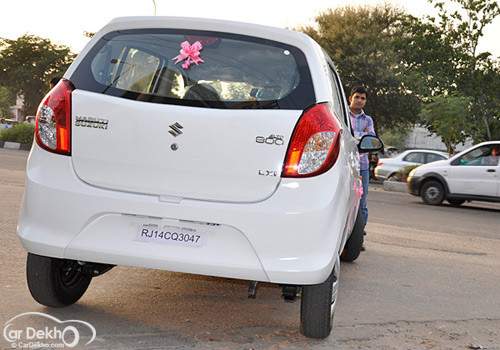
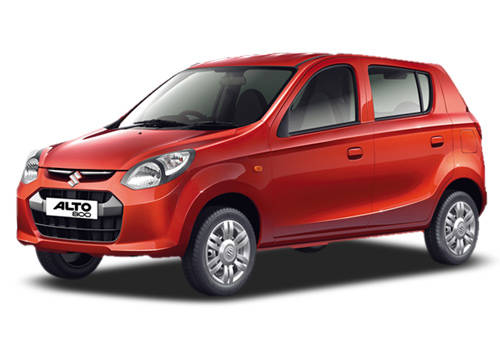
25 June, 2012: Maruti Suzuki for a while has been testing a new 800cc engine for their bestseller Maruti Alto.The test mule with Alto 800 badging has been recently caught on lenses giving the market a hint about what to expect with the revamped car. The overhauled Maruti Alto will come with an all new front fascia
Alto 800
 that features small grille and laid back headlamps. The lower grille has adopted a hexagonal shape and is akin to the grille offered by Ford Figo.The new Alto 800 has also gone taller and offers more headroom space. New Maruti Alto 800 seems like a fresh breath of air and represents Maruti India’s new design philosophy. However, the profiling still resembles Alto’s sibling Maruti A-Star,  as the new 800 Alto has got the same old-school boot-lid and rising beltline. The market is also expecting that Maruti Suzuki might even tweak the 800cc engine for not just better fuel efficiency but also for better performance.Watch Video Note That video is not this site property

I have an Alto LX since MAY 2007 and till now I have done around 5000 Kms. I was a bachelor and just need a car for  daily use(home-office) and also my budget was 3 lacs. So I opted for an alto and till now if not very happy, I am satisfed with it. So here are some facts based on my experience:
The good things:
1. Till now I haven't faced any technical probelm related to engine or suspension or a/c. etc, its a trouble free car.
2. Fuel economy is perhaps best for a petrol car.
city: 15-17 kmpl[w/o a/c], 14-15 kmpl[with a/c]
highways: 20-22 kmpl[w/o a/c], 18-20 kmpl[with a/c]
3. Spare parts are cheap and easily available, also there are lot of service centres. So maintenance is not a problem with alto.
4.. The A/C is great, can chill you within 5 minutes even at 40C.
Now the bad things:
1. Pickup with a/c is very poor, you will have to turn it off if you need to overtake.
2. The interiors are very cramped specially the back seats, not enough space for luggage.
3. Feels powerless on highways, becomes unstable above 100kmph. Not comfortable for long drives. Night riding is quite painful.
Verdict: If you ride a 2 wheeler for city use and need a roof over your head with a/c then go for this car. Also its a good car for 1st time car owners specially bachelors or small families. But
I have an Alto LX since MAY 2007 and till now I have done around 5000 Kms. I was a bachelor and just need a car for  daily use(home-office) and also my budget was 3 lacs. So I opted for an alto and till now if not very happy, I am satisfed with it. So here are some facts based on my experience:
The good things:
1. Till now I haven't faced any technical probelm related to engine or suspension or a/c. etc, its a trouble free car.
2. Fuel economy is perhaps best for a petrol car.
city: 15-17 kmpl[w/o a/c], 14-15 kmpl[with a/c]
highways: 20-22 kmpl[w/o a/c], 18-20 kmpl[with a/c]
3. Spare parts are cheap and easily available, also there are lot of service centres. So maintenance is not a problem with alto.
4.. The A/C is great, can chill you within 5 minutes even at 40C.
Now the bad things:
1. Pickup with a/c is very poor, you will have to turn it off if you need to overtake.
2. The interiors are very cramped specially the back seats, not enough space for luggage.
3. Feels powerless on highways, becomes unstable above 100kmph. Not comfortable for long drives. Night riding is quite painful.
Verdict: If you ride a 2 wheeler for city use and need a roof over your head with a/c then go for this car. Also its a good car for 1st time car owners specially bachelors or small families. But if you can rise a little above 3 lacs, then go for 1000cc cars, they are much better.

December Discount

The year-end brings with it a whole host of reasons for car buyers to celebrate. This time of year is one of the best to seal the deal on the car of your choice, as carmakers dish out huge deals and discounts in a bid to clear their inventories.
Kicking off the list is Hyundai. The carmaker is offering a cash discount of Rs 60,000 on all the variants of its Santa Fe SUV.

Fiat is also offering a whole range of discounts on the Linea. The Linea 1.4 Active Absolute edition is being offered with free insurance worth Rs 25,848, a cash discount of Rs 25,000, an exchange bonus of Rs 15,000 and a corporate discount of Rs 7,000, equaling to a chunky savings of Rs 72, 848. The Linea 1.4 Dynamic Absolute edition also has similar cash, exchange bonus and corporate discounts, but the free insurance worth Rs 29,325 bumps the total savings to Rs 76,325. If you’re in the market for the diesel Linea, however, there are even bigger gains to be had. The Absolute edition of the Active, Dynamic and Emotion packs stretch up to Rs 76,442, Rs 80,026 and Rs 81,281 respectively.

Potential Honda owners will have much reason to rejoice this year end. Dealers are offering a fat Rs 2,50,000 discount on the Accord 2.4 AT and the Accord V6 AT. The Civic, which is now discontinued, is also being offered with a hefty Rs 1,50,000 discount on all trim levels.
Mahindra also has deals on its Scorpio and Xylo. The Scorpio VLX 4x4 is being offered with free insurance worth Rs 46,015 and an exchange bonus of Rs 10,000, while the VLX 4x2 trim is being offered with free insurance worth Rs 43,393 and a similar exchange bonus of Rs 10,000. The Scorpio VLX fitted with an auto ‘box has quite a big discount on of Rs 58,992, which includes free insurance worth Rs 48,992 and an exchange bonus of Rs 10,000. The Xylo E8 can be bought with free insurance worth Rs 44,862 and an exchange bonus of Rs 10,000, totalling up to Rs 54,862 in savings.
Skoda is offering very tempting discounts on its Laura with the 2.0-litre diesel motor. The L&K AT is being sold with a cash discount of Rs 90,000, along with a corporate discount of Rs 17,500, bringing the total discount to a whopping Rs 1,07,500. Similar discounts are being offered on the Ambience AT, Elegance, Ambiente and Elegance AT trim levels. The Superb’s 1.8 TSI trim levels are being sold with an even greater discount. The Ambition MT, Elegance MT, and Elegance AT are all being offered with a cash discount of Rs 1,50,000 and a corporate discount of Rs 12,500. The Superb’s 2.0 TDI’s Ambition AT and Elegance AT trim levels are also being sold with similar discounts totalling up to Rs 1,62,500.
Perhaps the biggest discount, however, is the one Tata is offering. There is a huge cash discount of Rs 2,00,000 and an exchange bonus of Rs 50,000 to be had on all the trim levels of the Aria.

With such tempting discounts on the table, this is the best time to go out and splurge on the car of